

Pregnancy can reveal health risks that extend far beyond childbirth. In new guidance released by the American Heart Association, American Academy of Pediatrics, American College of Obstetricians and Gynecologists, and the Society for Maternal-Fetal Medicine, experts identify pregnancy as a critical opportunity to detect cardiovascular disease risk earlier and connect women to care that can improve health outcomes for years to come.
Cardiovascular disease is the leading cause of death among women in the United States, claiming more than 400,000 lives each year. Yet only about 4 in 10 women recognize heart disease as their leading health threat. The new guidance notes that complications such as high blood pressure during pregnancy, gestational diabetes, preterm birth, and having a baby who is small for gestational age can serve as warning signs of future cardiovascular disease.
The guidance is the first coordinated framework developed by the four organizations and reflects a growing understanding that women’s cardiovascular health is shaped by experiences across the life course. Pregnancy, according to the authors, can act as a biological “stress test,” uncovering health risks that may otherwise go unnoticed until much later in life.
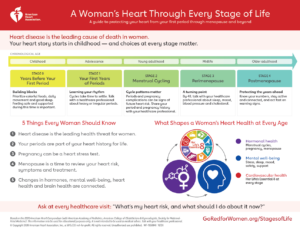
Heart health is shaped across the life course. The American Heart Association’s life stage framework highlights how menstrual history, pregnancy, menopause, mental well-being, and cardiovascular health can provide important insights into heart health at every age.
Download the Life Stage Overview Graphic.
For advocates focused on infants, toddlers, and families, these findings underscore the importance of supporting maternal health before, during, and after pregnancy.
Healthy development begins long before a child’s first birthday. The first 1,000 days, from pregnancy to age 2, are a major period of brain growth. Throughout pregnancy, maternal nutrition and mental health play an important role in a child’s long-term growth and well-being. Access to quality prenatal care, ongoing postpartum care, nutrition assistance, and family-supporting policies can help women address health concerns early while laying a stronger foundation for their children’s well-being. When mothers receive the care and support they need, families and communities benefit.
The guidance also highlights a significant gap in care. Only about 60% of women who experience high blood pressure disorders during pregnancy receive follow-up care within six months after giving birth. Missing these opportunities can delay treatment and increase the likelihood that cardiovascular risks go unaddressed.
For the National Collaborative for Infants and Toddlers (NCIT), the report reinforces a core principle: maternal health and child health are deeply connected. Investments in maternal health care, nutrition support, paid family and medical leave (PFML), and other prenatal-to-three supports help families navigate critical periods of development while creating opportunities for healthier futures.
The new framework calls for a more coordinated approach to women’s health, one that connects care across specialties and recognizes that pregnancy outcomes can provide important insights into lifelong health. By identifying risks earlier and ensuring women receive appropriate follow-up care, health systems, policymakers, and advocates can help improve outcomes for mothers and children alike.
Because supporting healthy beginnings is about more than pregnancy alone. It is about ensuring women have the care, resources, and support they need throughout the prenatal-to-three years and beyond.
Learn More
The new framework for women’s cardiovascular health highlights the importance of connecting maternal health, postpartum care, and long-term well-being. Explore the original guidance, press release, and related resources below.
American Heart Association news releases:
- Leading health groups redefine heart health for girls and women – For the first time, four medical societies have created a shared framework and clinical guidance that connect women’s heart health to distinct life stages, helping clinicians identify cardiovascular risk and act earlier.
-
Grupos líderes en el ámbito de la salud redefinen la salud cardíaca de las niñas y las mujeres – Por primera vez, cuatro sociedades médicas han creado un marco común y una guía clínica que relacionan la salud cardíaca de las mujeres con las distintas etapas de la vida, lo que ayuda a los médicos a identificar el riesgo cardiovascular y a tomar medidas más tempranas
-
Why every stage of life matters for a woman’s heart health – How do life stages shape women’s heart health? A landmark series of American Heart Association publications explores connections among hormonal changes, mental health and well-being and cardiovascular health
Manuscripts
- Presidential Advisory: A Female-Specific Life Course Approach to the Prevention and Management of Cardiovascular Disease – establishes the female life stage construct and life course framework’
- Scientific Statement: Consensus Guidance for the Female-Specific Prevention and Management of Cardiovascular Disease – provides clinical guidance, including a multi-society guideline crosswalk
- Science Advisory: Comprehensive Centers of Excellence for Women’s Cardiovascular Care – maps the current landscape of women’s cardiovascular centers and proposes a national infrastructure
Additional Resources
- Infographic (PDF) – My Heart & Health Checklist – Questions to think about before your next visit
- American Heart Association news release: Why every stage of life matters for a woman’s heart health
- American Heart Association News story: Why every stage of life matters for a woman’s heart health
- What Women Need to Know – Young Adulthood Infographic (PDF). Learn more about supporting good heart health in pregnancy and postpartum.
